

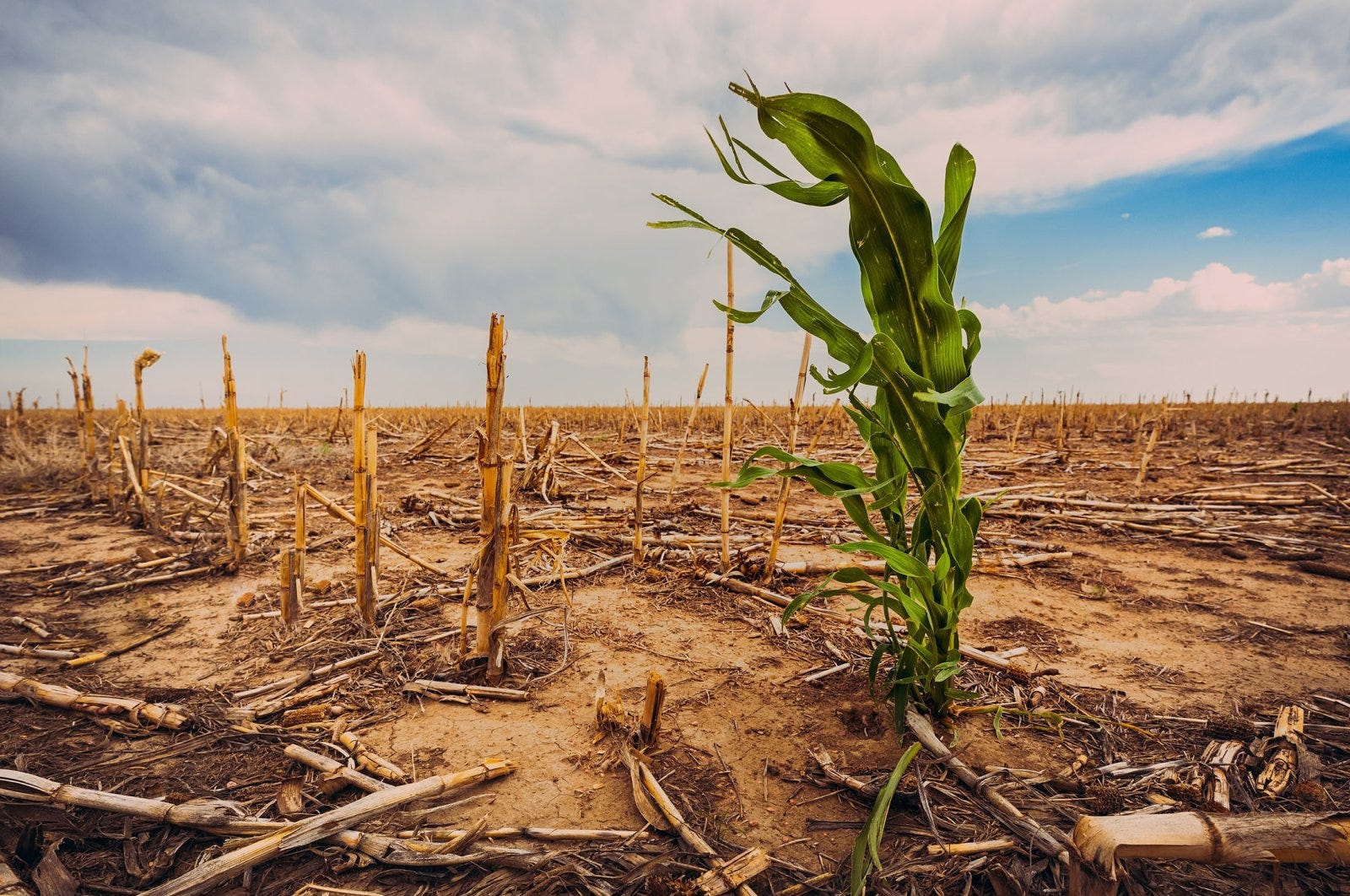
One of the most hard-hitting presentations at the recent National Emergency Briefing at Westminster was delivered by Professor Paul Behrens on the topic of food security.
Of course, he was talking about the UK, but almost everything he said about the UK’s vulnerabilities also apply to New Zealand.
In New Zealand we love to say that agriculture is the backbone of our economy and that ‘we feed the world’ with our food. But few people in any positions of influence – either in government or the industry itself – acknowledge how incredibly vulnerable our food system is. We may ‘feed the some of the world’ (with meat and dairy products mainly) but we depend on the rest of the world to do that.
Our highly industrialised and intensive agricultural system relies on the following inputs, all of which are imported from overseas:
Diesel and fossil fuels – without diesel, farm machinery would not run and food could not be cool-stored or distributed.
Fertiliser – Around 400 thousand tonnes of urea fertiliser is used annually on New Zealand farms and is the dominant form of fertiliser. This is made using natural gas, which is a fossil fuel. While some is currently produced domestically with a dwindling supply of natural gas, most is imported, including from Saudi Arabia, China and Canada.1
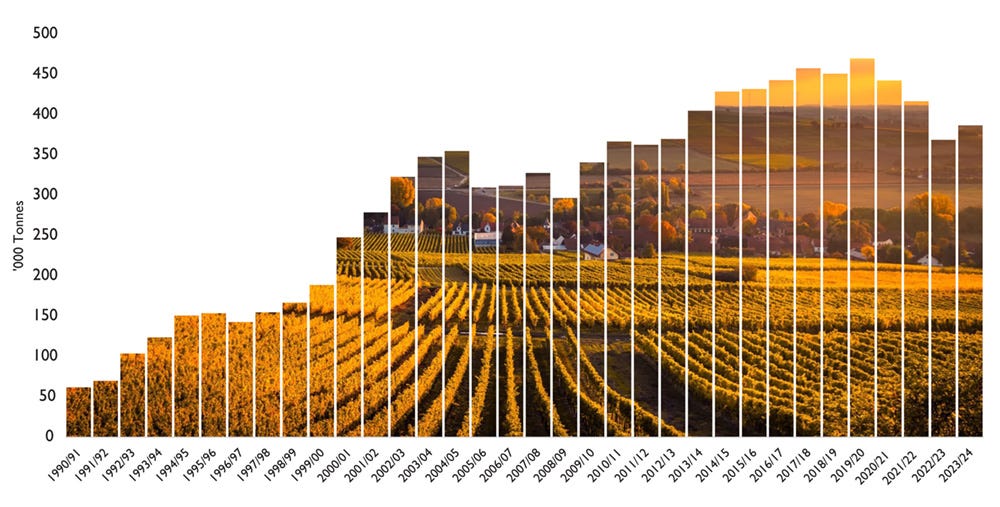
Nitrogen fertiliser use in New Zealand, in thousand tonnes of nitrogen. Data source: Fertiliser Association. (Source: https://www.fertiliser.org.nz/about-fertiliser/fertiliser-use-in-nz) Pesticides, weedicides and other agricultural chemicals
Seeds – while we produce many seeds in New Zealand, we also rely on imported seeds for specialised crops. PGG Wrightson, the primary seed supplier in New Zealand in now owned by global player DLF Seeds.
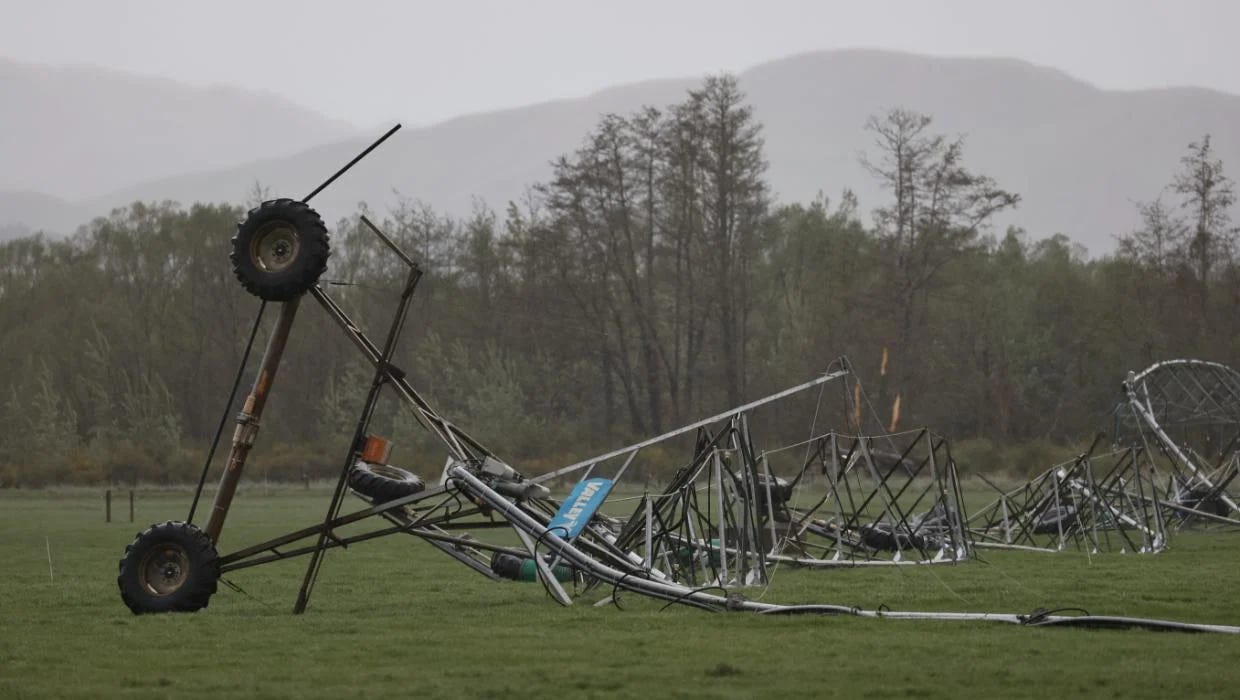
Farm machinery and parts – most of our agricultural machinery and parts are imported. This vulnerability was starkly demonstrated in the 2025 storm in Canterbury and Southland, when numerous pivot irrigators were irreparably damaged.
And finally, there is the food we eat.
While we do produce a surplus of meat and dairy products (which get exported) and plenty of vegetables and many fruits, many staples such as wheat, rice and other grains, legumes, sugar – not to mention those critical essentials chocolate and coffee! - are imported.
Paul Behrens notes that the UK imports around 40% to 50% its food. But at least the UK has done the analysis and acknowledges this vulnerability. Successive New Zealand governments have failed to do any kind of national food security assessment. Our government’s motto seems to be “ignorance is bliss”. But that is far from the truth.
As Professor Behrens observes, climate change-induced food insecurity is already starting to bite. Even before we experience outright shortages in staples such as wheat and other grains, climate change is already a major contributor to food inflation at a time when people are already struggling. He cites one study that identified that a third of the food price inflation in the UK in 2023 was caused by extreme weather events. Again, we don’t have the equivalent analysis for New Zealand, compared to 2022, in 2023 there was 56% increase in the cost of a selected food items.2
In other words, climate change is not an issue separate from the cost of living crisis. It IS the cost of living crisis.
And, when families can’t afford to feed their children, societies break down. When food security experts in the UK are asked about the likelihood of civil unrest driven by food supply crises, 40% say it’s possible within a decade on the current path. 80% say that it’s possible within 50 years. What does the New Zealand government’s analysis tell us? That’s right – there isn’t any. We have no Food Security Assessment. We have not Food Security Strategy.
Professor Behrens makes many important points and I highly recommend viewing his 13-minute talk in full.
However, a central theme throughout is the urgent need to shift to a more plant-rich diet: for its climate benefits, environmental benefits, for its national food security benefits and of course for its health benefits.
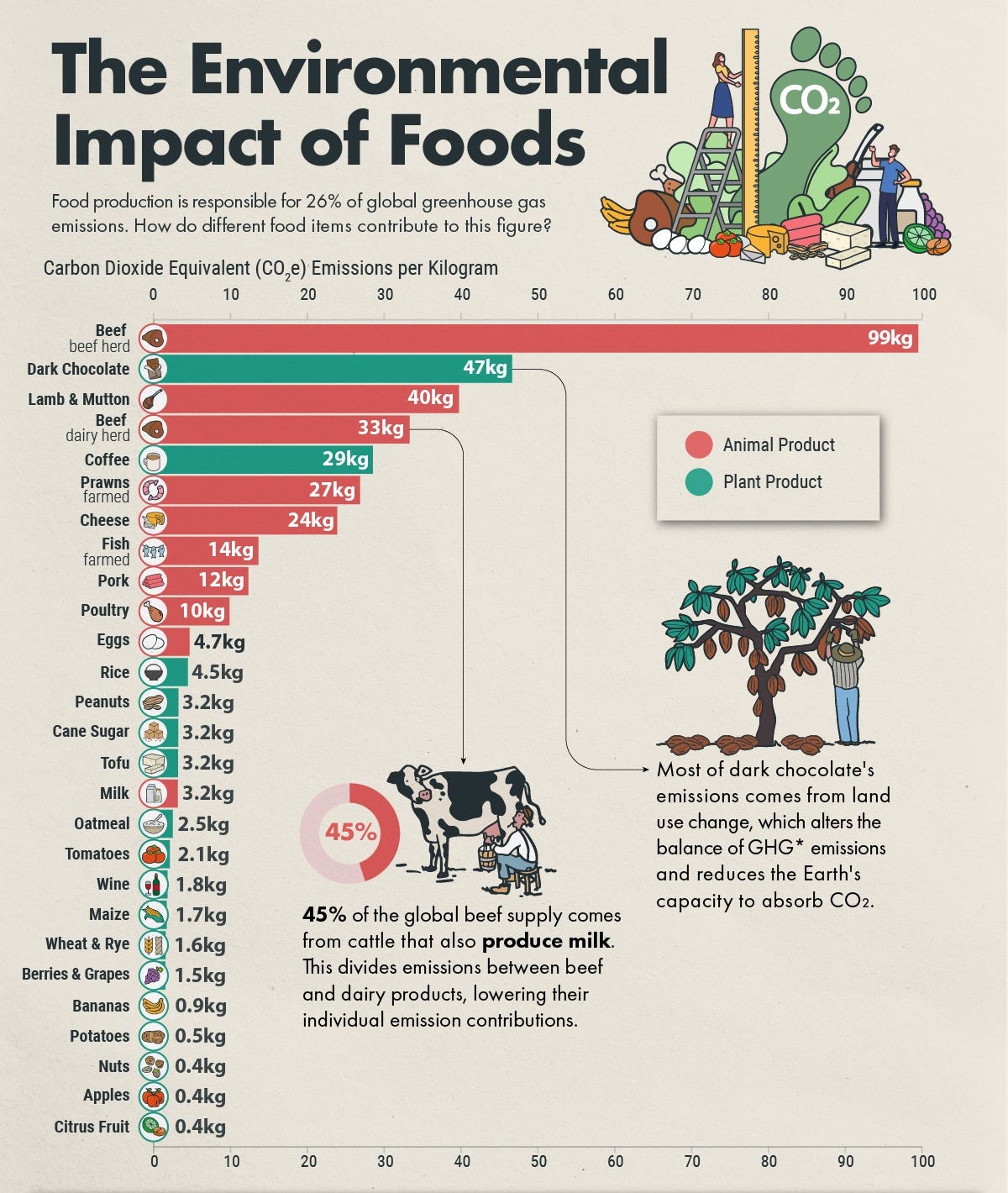
Based on the findings of the UK National Food Strategy, shifting land use away from animal protein production to plant production, more food can be produced with a greatly reduced impact on the climate and environment. The production of animal proteins (meat and milk) is highly demanding on on land, water (both in terms of its consumption and discharge of pollution),3 energy, as well as being heavily dependent on imported resources such as urea fertiliser and animal feed such as palm kernel. It also produces much more climate-heating emissions, as can be seen in the chart below.
Of course such a transition would also bring huge benefits in terms of human health and animal welfare (particularly in a heating climate) as well.
I will leave the last words to Professor Behrens:
So we face a choice. We can continue with business-as-usual, watching our food systems crumble, watching the costs rise, our resilience erode, and then bracing ourselves for political and civil unrest.
Or we can act now to improve our health, our environment, our rural livelihoods, our communities, along with improving our ability to roll with the punches of climate change. We’ll look back and wonder why we didn’t make these changes sooner.
Food security will be one of the topics in the upcoming Reality of Everything Symposium. Find out how to support this important initiative and secure your place here.
Prior to the 1990s, pastoral systems were almost solely reliant on clover to fix nitrogen (https://www.fertiliser.org.nz/about-fertiliser/fertiliser-use-in-nz).
https://www.worldvision.org.nz/about/media/food-price-spikes-nz-joins-worlds-poorest/
In New Zealand, intensive agriculture is poisoning our waterways and groundwater, with nitrate levels in Canterbury soaring to dangerous levels and about half of our rivers and lakes unsuitable for swimming, primarily due to landuse impacts.
Thanks Catherine, excellent post. In our own work on a NZ Food Security Strategy, we looked at abrupt catastrophe (as opposed to chronic inexorable climate impacts - both need to be addressed). In the face of trade and supply collapse, nuclear or volcanic winter, etc we deduced some first principles for food security including: explicit plans/logistics for pivot of export food to local consumption, land zoning and growing more near to cities, consume local, reduce the ratio of industrial inputs to protein/food energy outputs (which in practice means eg grains rather than dairy), crop selection calibrated to risk (eg both climate heating and extended frost period resilience for a hotter world at risk of abrupt sunlight reduction events, eg nuclear war), local production of key inputs like liquid biofuel, etc. See our blog integrating these several strands of thinking (the blog links to several technical papers): https://adaptresearchwriting.com/2025/05/07/catastrophe-proof-food-security-for-new-zealand-blending-near-urban-agriculture-strategic-crop-selection-and-biofuels-as-insurance-against-global-catastrophes/
And also our 2023 ‘NZCat’ report that explicitly echoes the call for a National Food Security Strategy, and outlines what a catastrophe response plan for food might look like for the case of northern hemisphere nuclear war (‘Food’ starts on p.28): https://adaptresearchwriting.com/wp-content/uploads/2023/11/231117-v1-nzcat-resilience-nuclear-gcrs-1.pdf
Overall a strong upvote from me that we need a national approach to all this that is integrated. And this is just one system, other critical systems suffer the same issues. We need something like a national Chief Risk Officer or Parliamentary Commissioner for Catastrophic Risk to oversee the joining up of this large-scale risk thinking.
The situation is the same in Australia, it is an invisible problem, like heat - it seems that when we can't visualise the processes, impacts and machinations of our food production systems, we (society) lack any way to think about them, let alone challenge them. This is how ethically indefensible CAFO systems - concentrated animal feeding operations - have become such an unacknowledged driver of climate change. Artists are vital to any solution.